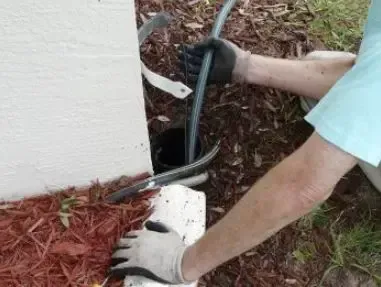
Tree Root Drain Blockages in Pickerington Ohio Yards
Pickerington yards carry a hidden threat beneath the lawn every spring. As soil temperatures climb and moisture levels rise along Refugee Road corridors and throughout the established neighborhoods near Violet Township, tree roots accelerate their search for water and nutrients. Older clay sewer laterals buried just a few feet underground become prime targets. What begins as a hairline crack or a loose pipe joint turns into a full root intrusion event that backs up toilets, slows floor drains, and eventually causes sewage to surface in your yard. Understanding why this happens here, and what actually fixes it, saves homeowners from repeat service calls and wasted money.
Why Pickerington Soil and Tree Mix Creates Root Intrusion Problems
Fairfield County clay soil holds moisture unevenly. During dry stretches, it compresses and pulls away from buried pipe joints, creating small gaps. Roots detect the vapor and humidity leaking from those gaps and grow directly toward the source. Pickerington's tree canopy skews heavily toward silver maples, Norway maples, and willows — all species with aggressive, shallow root systems. Subdivisions platted in the 1980s and 1990s along Hill Road and near the older Diley Road corridor planted these fast-growing species as street trees. Thirty years later, those root systems have spread far beyond the original planting zone and now run parallel to, and sometimes directly through, residential sewer laterals.
Clay tile pipes installed before the 1980s have bell-and-spigot joints every two to three feet. Each joint is a potential entry point. Once a root tip enters a joint, the root grows thicker over time, splitting the pipe further. Plastic PVC laterals from the 1990s are more resistant but not immune — a cracked section or an improperly glued joint will allow root entry just as readily as old clay.
Seasonal Patterns That Trigger Root Blockages
Root-related drain calls in Pickerington cluster in two windows. The first is April through June, when rapid root growth coincides with spring rain saturation. Root tips are metabolically active and extend aggressively during this period. Any existing intrusion that went unnoticed through winter will suddenly produce full blockages as new root material fills the pipe cross-section. The second window is September and October, when trees pull in final resources before dormancy. Homeowners often notice slow drains in late summer that become complete stoppages by October.
Winter is actually the quietest period for new root growth, but it can reveal existing damage. Cold temperatures cause clay pipes to shift slightly. If roots have already weakened the pipe structure, a hard freeze can crack compromised sections outright, turning a root problem into a broken lateral problem.
How Root Blockages Differ From Other Drain Problems
Not every slow drain is a root problem, but certain patterns point strongly toward root intrusion. Multiple slow fixtures in your home draining simultaneously — especially toilets, the main floor drain, and lowest-level fixtures — suggest the blockage is in the main lateral, not in an individual branch line. Root blockages also tend to develop gradually rather than appearing overnight. If you have noticed your drains slowing progressively over a season and noticed gurgling sounds in the toilet when running a sink, root intrusion is a strong candidate.
Grease blockages, by contrast, tend to localize in kitchen lines and clear predictably with hot water and enzymatic treatment. Root blockages rarely respond to consumer-grade drain chemicals, and foaming root killers sold at hardware stores provide only temporary suppression — they do not remove existing root mass from inside the pipe.
For background on how different blockage types present inside the home, the older kitchen drain blockage context provides useful comparison for homeowners trying to diagnose which system is actually involved.
Permanent Root Removal Methods That Work
Mechanical cutting is the starting point for any serious root intrusion. A professional drain snake equipped with a root-cutting blade can clear the pipe cross-section and restore flow. This is not a permanent fix on its own — cutting removes the root mass inside the pipe, but the entry point remains. Without additional steps, regrowth appears within six to eighteen months depending on root species and seasonal activity.
Hydro-jetting follows mechanical cutting in most professional approaches. High-pressure water at 3,000 to 4,000 PSI flushes remaining root fragments, scrubs the pipe wall, and clears debris that accumulated behind the root mass. Hydro-jetting also helps seat loose joints temporarily while the overall pipe condition is being assessed.
Camera inspection after clearing is essential. A sewer camera identifies exactly where roots entered, how many entry points exist, and whether the pipe has structurally failed. This step determines whether cutting and jetting is a viable long-term approach or whether the lateral needs lining or replacement. In Pickerington's older sections, camera inspection frequently reveals multiple entry points across a single lateral run, which changes the repair recommendation entirely.
Pipe lining — cured-in-place lining — is the most durable solution when the pipe structure is still intact but root entry points are confirmed. A resin-saturated liner is inserted and cured against the pipe wall, creating a seamless interior that eliminates joints and blocks future root entry. This approach avoids excavation in most cases and is particularly practical in established Pickerington yards where mature landscaping makes open trenching expensive and disruptive.
Full lateral replacement is necessary when camera inspection reveals collapse, offset joints, or root damage severe enough that lining cannot bond properly. Trenchless replacement methods reduce yard disruption significantly compared to traditional open-cut methods.
What Pickerington Homeowners Should Do This Spring
If your home sits in a subdivision platted before 2000, has mature maples or willows within forty feet of the house, and you have not had a sewer lateral inspection in the past five years, spring is the right time to schedule a camera inspection before problems develop into emergencies. Proactive inspection costs a fraction of emergency service calls or sewage cleanup.
Avoid planting willow, silver maple, or cottonwood species near sewer lines. When replacing landscaping along the Diley Road and Hill Road corridors where older pipe infrastructure is common, choose deep-tap species like ornamental pear or serviceberry that are far less aggressive in lateral spread.
Professional Drain Cleaning with root-cutting capability is not the same as standard drain snaking. When contacting a plumber, confirm they carry camera inspection equipment and root-cutting heads, not just standard cable machines. The distinction determines whether you are getting a diagnostic service or a temporary fix.
Long-Term Perspective on Root Management
Root intrusion in Pickerington is not a problem that disappears with a single service call. It is an ongoing condition driven by aging infrastructure, established tree canopy, and seasonal soil behavior. Homeowners who understand the cycle — spring growth, fall activity, winter stress — are positioned to manage it with scheduled maintenance rather than reacting to sewage emergencies. Annual or biennial mechanical cutting combined with periodic camera checks is a realistic maintenance approach for properties with known root intrusion history. The goal is keeping the pipe clear and catching structural deterioration before it forces emergency excavation.
